How long do solar storage batteries last in 2026? The practical answer depends on chemistry, daily use, temperature, and how well the system is installed. Many home lithium-ion batteries are designed to serve for roughly 10 to 15 years, but that is an estimate, not a promise. A warranty often lasts around 10 years and may specify a minimum remaining capacity or energy throughput. Read those terms closely. The headline number can hide important conditions.
Picture a battery mounted in a garage through hot summers and cool winters. Frequent deep discharges, poor ventilation, or settings that keep it nearly full may affect its long-term performance. Battery management software and careful system sizing matter, too. Real homes rarely match laboratory conditions. That gap deserves attention.
This guide explains how to compare expected service life, warranty coverage, and gradual capacity loss when evaluating solar storage in 2026. It also looks at differences between lithium-ion and other battery types, and at the signs that a battery may be nearing replacement. A shorter runtime on cloudy evenings can be noticeable, but it does not automatically mean the battery has failed. Review system data and consult a qualified installer before drawing conclusions. Estimates vary. Even reputable specifications cannot predict every household’s results, so treat any single lifespan figure with healthy skepticism.
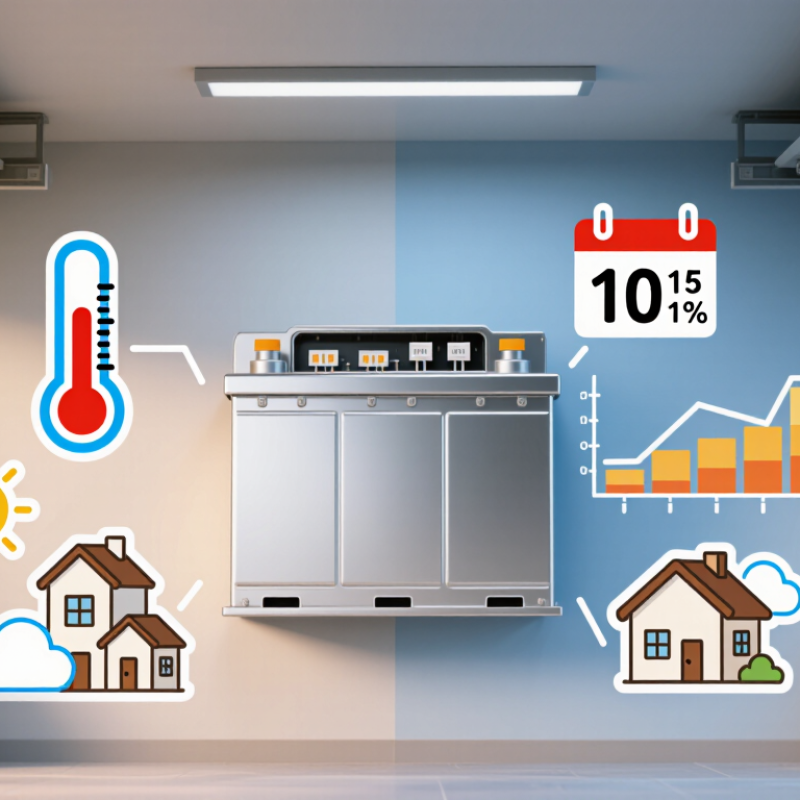
For most homes, a solar storage battery is a 10-to-15-year component, not a lifetime purchase. The U.S. Department of Energy’s Energy Saver guidance gives a wider 5-to-15-year range, reflecting differences in chemistry, operating conditions, and use. NREL’s 2024 Annual Technology Baseline models lithium-ion storage with a 15-year lifetime. That figure is a planning assumption, not a guarantee for every household. Not a fixed countdown.
Real-world life depends on heat, charging patterns, and how deeply the battery is discharged each day. A unit in a hot garage may age faster than one kept within its recommended temperature range. Capacity usually fades gradually: the battery may still work, but store less power for evening lights or a refrigerator. Check the warranty’s stated years, energy throughput, and remaining-capacity threshold; these details matter more than a single lifespan estimate. Keep the installation area well ventilated, follow the operating guidance, and review performance records each year. Even careful owners cannot control every factor, and that uncertainty is easy to underestimate.
| Battery type | Typical service life | Approx. cycle life* | Common warranty period | Typical end-of-warranty capacity | Practical notes |
|---|---|---|---|---|---|
| Lithium iron phosphate (LFP) | About 10–15 years | About 4,000–10,000 cycles | Often 10 years | Commonly around 60–70% | Long cycle life and good thermal stability; actual life depends on operating conditions and warranty throughput limits. |
| Lithium nickel manganese cobalt oxide (NMC) | About 8–12 years | About 2,000–6,000 cycles | Often 10 years | Commonly around 60–70% | Compact and energy-dense; high temperatures and frequent deep discharges can accelerate degradation. |
| Lead-acid, flooded | About 3–7 years | About 500–1,500 cycles | Often 1–5 years | Varies by warranty and usage | Usually requires ventilation and periodic maintenance; repeated deep discharge shortens service life. |
| Lead-acid, AGM | About 4–8 years | About 600–1,200 cycles | Often 1–5 years | Varies by warranty and usage | Sealed and generally maintenance-free, but capacity and lifespan are sensitive to deep cycling and heat. |
| Lead-acid, gel | About 5–10 years | About 700–1,500 cycles | Often 1–5 years | Varies by warranty and usage | Sealed construction; charging must follow the battery maker’s specified voltage limits. |
*Cycle-life figures are approximate and depend on depth of discharge, temperature, charge rate, and operating strategy. A battery’s warranty may set both a time limit and an energy-throughput or cycle limit; check the specific warranty for its capacity-retention terms. Service life is an estimate, not a guarantee.
Some planning models use a 15-year lifetime for lithium-ion storage. That is an estimate, not a promise. Heat, cycling, and installation conditions can change the outcome.
Yes. Lithium iron phosphate cells may tolerate more charge cycles than some other lithium-ion types. Lead-acid batteries generally benefit from shallower discharges. Design and use still matter.
Yes. High temperatures can speed chemical aging. A hot garage or poorly ventilated utility room is worth checking.
They may stress many batteries. Note how often the battery empties fully, especially during cloudy weeks. One week proves little.
Compare current performance with commissioning records. For example, check whether the battery still powers evening lights and a refrigerator until morning. Compare similar weather and household use.
They can be. Review monitoring history and recurring fault alerts, then ask a qualified installer to test the battery and inverter.
Not necessarily. Cloudy weather or changed household use may explain it. Still, I might be reading too much into one bad week; repeated capacity drops deserve attention.
Stop using the system if it is safe to do so, and contact a qualified professional promptly. Don’t wait for another alert.
How long do solar storage batteries last depends on their chemistry, operating conditions, and daily use. Many home battery systems are designed to provide around 10 to 15 years of service, but their usable capacity gradually declines over time. Frequent deep discharges, high temperatures, and heavy cycling can shorten service life, while moderate use and a suitable installation environment may help a battery perform well for longer.
To assess expected longevity, compare cycle-life ratings with warranty terms, including any capacity-retention guarantees and usage limits. A noticeable drop in stored energy, shorter backup periods, or irregular performance may indicate that replacement planning is needed. Regularly monitoring performance, avoiding unnecessary deep discharges, and following the manufacturer’s maintenance guidance can help extend battery life. Planning ahead also allows homeowners to consider future energy needs and budget for replacement before the existing system no longer meets them.

 Ansar Energy